
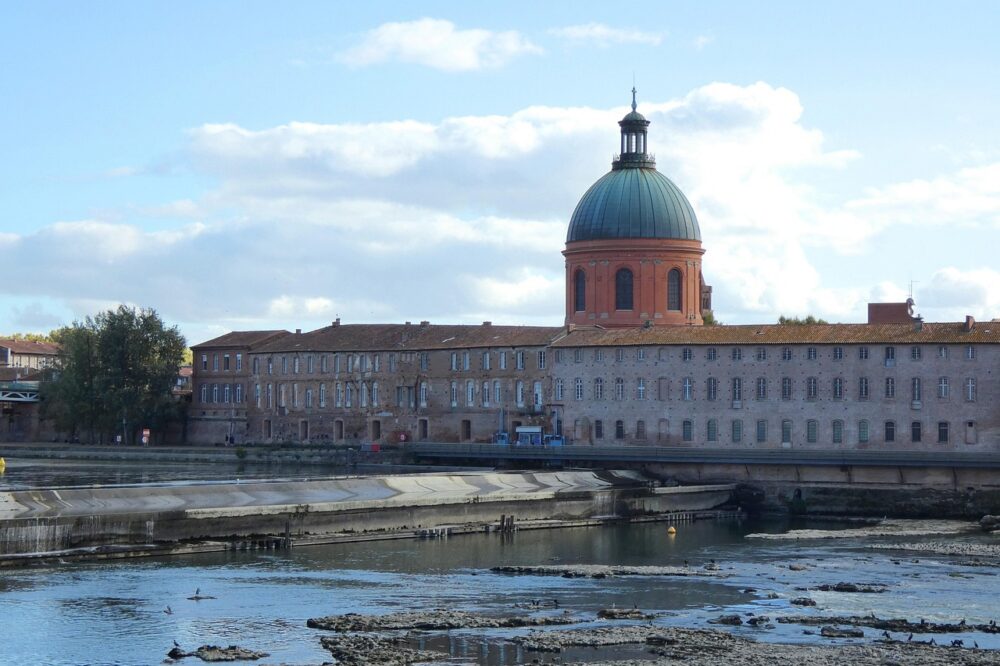
Toulouse, often called La Ville Rose (the Pink City), owes its nickname to the distinctive terracotta bricks used in its buildings. But the architecture in Toulouse is far more than a uniform color palette—it spans Romanesque churches, medieval half-timbered houses, Renaissance mansions, neoclassical squares, and cutting-edge contemporary structures. This guide unpacks the key styles, landmarks, and hidden gems that define the city’s built environment, helping you understand and appreciate its architectural evolution.
Table des matières:
The Signature Material: Terre Cuite Brick
Before exploring specific styles, you need to know the city’s defining building material: terre cuite (baked clay) brick. Locally sourced from the Garonne river plains, this brick gives Toulouse its warm pinkish hue. The brick is relatively soft and easy to carve, which allowed medieval and Renaissance builders to create intricate moldings, cornices, and decorative arches. It also absorbs heat during the day and releases it at night—a practical advantage in the Occitan climate.
Unlike Parisian limestone or northern flint, Toulouse brick weathers gracefully, developing a patina that deepens the pink color over centuries. When you walk through the historic center, notice how the brick appears almost orange in direct sunlight and subtly mauve in shade.
Romanesque Beginnings: Basilica of Saint-Sernin
The most iconic Romanesque building in Toulouse—and one of the largest in Europe—is the Basilica of Saint-Sernin, a UNESCO World Heritage site on the Camino de Santiago. Its architecture is defined by a massive bell tower, a five-aisled nave, and a radiating chevet with chapels. Built between the 11th and 12th centuries from local stone and brick, it exemplifies the pilgrimage church typology: wide transepts, ambulatory, and galleries to accommodate crowds of pilgrims.
The basilica’s exterior is sober but imposing, with blind arcades and Lombard bands. Inside, the soaring vaulted ceiling and the play of light through the apse windows create a solemn atmosphere. Look for the Miegeville portal with its intricate carvings of biblical scenes—a masterpiece of Romanesque sculpture.
Key Features to Observe
- Octagonal bell tower with five tiers (the upper two added in the 13th century)
- Chevet with radiating chapels
- Alternating stone and brick bands in the walls
- Large rose window (13th century) on the south facade
Gothic Flourishes: The Jacobins Convent
While Toulouse has no massive Gothic cathedral (the current Cathedral of Saint-Étienne is an awkward mix of styles), the Couvent des Jacobins is a breathtaking example of southern French Gothic. Built by the Dominican order between 1230 and 1340, its church features a double nave separated by a central row of columns, a design unique to mendicant orders. The star-shaped vault of the apse, with its palm tree-like ribs, is an engineering marvel that seems to defy gravity.
The convent’s cloister, with its slender twin columns and pointed arches, offers a peaceful retreat from the city bustle. The adjacent refectory, chapter house, and cellars are also open to visitors. The Jacobins complex is a must-see for anyone interested in religious architecture and medieval construction techniques.
Renaissance Mansions: Hôtels Particuliers
In the 16th and 17th centuries, wealthy merchants and parliamentarians built lavish private mansions known as hôtels particuliers. Toulouse has over 50 of these, many concentrated in the Carmes and Saint-Étienne neighborhoods. They blend Gothic structures with Renaissance ornamentation: courtyards, stair towers, galleries, and sculpted doorways.
One of the finest is the Hôtel d’Assézat, built for a woad merchant. Its facade is a textbook example of the French Renaissance style—pilasters, pediments, and medallions—all executed in pink brick and white stone. The inner courtyard features a monumental staircase and an arcaded gallery. Today it houses the Bemberg Foundation art collection.
Another highlight is the Hôtel de Bernuy, with its impressive courtyard and a staircase tower decorated with shell motifs. Many of these mansions are private property but can be glimpsed through open doors or visited during the annual Journées du Patrimoine (Heritage Days) in September.
Top 5 Hôtels Particuliers to See
- Hôtel d’Assézat (Place d’Assézat)
- Hôtel de Bernuy (Rue Gambetta)
- Hôtel de Felzins (Rue du Languedoc)
- Hôtel de Pierre (Rue de la Dalbade)
- Hôtel du Vieux-Raisin (Rue du Languedoc)
Neoclassical Grandeur: Place du Capitole and the Capitole Building
The Place du Capitole is the city’s main square and its architectural centerpiece. The Capitole building itself, built in the 18th century, houses the city hall and the Théâtre du Capitole. Its neoclassical facade, designed by Guillaume Cammas, stretches 135 meters long and features a peristyle of eight columns, a balustrade, and allegorical statues representing the four cardinal virtues—Justice, Temperance, Prudence, and Fortitude. The square is paved with pink bricks arranged in a cross pattern, echoing the city’s signature color.
Inside, the Salle des Illustres is a grand reception hall adorned with paintings, chandeliers, and a painted ceiling depicting the history of Toulouse. The building also contains the Henri Martin museum and the Théâtre du Capitole, one of France’s leading opera houses.
19th-Century Transformations: Haussmannian Influence and Industrial Architecture
Like many French cities, Toulouse underwent urban renovation in the 19th century. The Rue de Metz and Rue d’Alsace-Lorraine were carved through the medieval fabric, lined with uniform buildings in the Haussmannian style—though adapted to local materials. These buildings have the familiar mansard roofs, wrought-iron balconies, and stone ground floors, but often incorporate pink brick on upper levels.
Industrial architecture also left its mark: the Bazacle hydroelectric plant on the Garonne, built in 1888, is one of the world’s oldest and still produces electricity. Its brick-and-metal structure is a fine example of early industrial design. The Gare Matabiau station, with its grand train shed and neo-Renaissance facade, is another 19th-century gem.
Modern and Contemporary Landmarks
Toulouse’s 20th- and 21st-century architecture reflects its status as a hub for aerospace and technology. The Cité de l’Espace is a theme park with striking modern buildings, including a full-size replica of the Ariane 5 rocket. The Quai des Savoirs, a science center, occupies a renovated 19th-century factory with a contemporary glass extension.
The Pont Saint-Pierre and Pont des Catalans are elegant early 20th-century bridges. More recently, the Zénith de Toulouse concert hall (1999) by architect Jean Nouvel is a futuristic structure clad in metal and glass, contrasting with the historic skyline. The Médiathèque José Cabanis (2004) is a striking glass-and-steel building in the Compans-Caffarelli district.
Contemporary Architecture Checklist
- Zénith de Toulouse – Jean Nouvel’s iconic concert hall
- Médiathèque José Cabanis – modern glass cube
- Cité de l’Espace – space-themed structures
- Quai des Savoirs – industrial conversion with glass extension
- Hôtel-Dieu Saint-Jacques – historic hospital turned modern health campus
- Tour de la Garonne – residential tower with panoramic views
Common Mistakes When Observing Toulouse Architecture
First-time visitors often overlook the architectural variety because the pink brick creates a visual uniformity. They assume all old buildings are the same era. In reality, the brick spans Romanesque to Art Deco. Another mistake is focusing only on the Capitole and Saint-Sernin, missing the intimate Renaissance courtyards and the vibrant street art that interacts with historic facades. Finally, many don’t realize that the brick color changes with the light—visit at different times of day to see the full spectrum.
Practical Tips for Architecture Lovers
- Walk the historic center on foot—the best architecture is on small streets like Rue des Changes, Rue du Languedoc, and Rue de la Dalbade.
- Take a guided tour of the Jacobins convent and the Capitole’s Salle des Illustres.
- Visit the Cloister of the Jacobins for a quiet moment amid Gothic arches.
- Cross the Garonne to the Saint-Cyprien district for views of the pink brick skyline from the river.
- Check opening hours for hôtels particuliers—many are only open during Heritage Days.
- Use the metro to reach the Cité de l’Espace and Zénith.
Frequently Asked Questions
What is the architecture in Toulouse known for?
Toulouse architecture is famous for its extensive use of pink terracotta brick, which gives the city its nickname La Ville Rose. The city boasts a rich mix of Romanesque, Gothic, Renaissance, neoclassical, and contemporary styles, with landmarks like the Basilica of Saint-Sernin, Jacobins Convent, and Capitole square.
Why is Toulouse called the Pink City?
The nickname comes from the warm pinkish hue of the local brick (terre cuite) used in most historic buildings. The brick was sourced from the Garonne river clay and gives the city a distinctive, unified appearance.
What are the must-see architectural sites in Toulouse?
Key sites include the Basilica of Saint-Sernin, Jacobins Convent, Place du Capitole, Hôtel d’Assézat, Hôtel de Bernuy, and the modern Zénith de Toulouse. Also explore the Renaissance courtyards in the Carmes district.
Is Toulouse architecture similar to Paris?
No. Paris is dominated by limestone and Haussmannian uniformity, while Toulouse uses pink brick and has a more varied medieval and Renaissance character. The city’s architecture is more closely related to other Occitan cities like Albi and Montauban.
Can I visit the interior of Toulouse’s private mansions?
Some are open to the public year-round (e.g., Hôtel d’Assézat as the Bemberg Foundation). Others are private and only accessible during the annual Journées du Patrimoine (Heritage Days) in September.
What modern architectural landmarks should I see in Toulouse?
Don’t miss the Zénith de Toulouse by Jean Nouvel, the Médiathèque José Cabanis, the Quai des Savoirs, and the Cité de l’Espace. The Pont Saint-Pierre and Pont des Catalans are also notable early 20th-century bridges.
Final Thoughts
The architecture in Toulouse is a layered story of a city that has constantly reinvented itself while honoring its material heritage. From the Romanesque power of Saint-Sernin to the sleek lines of the Zénith, every era has left its mark in pink brick and stone. Whether you’re a casual traveler or a dedicated architecture enthusiast, exploring Toulouse’s streets is like walking through a living museum of French building traditions. Take your time, look up, and notice the details—the city rewards those who pause.
Photo by David L. Espina Rincon on Unsplash

The article mentions that brick changes color in different light. Is there a best time of day to see the pinkest hues?
Yes, the pink tone is most vivid during the golden hours of early morning and late afternoon. Direct sunlight brings out the warm orange-pink, while overcast or shady conditions reveal a more mauve shade. For the classic ‘pink city’ photos, aim for late afternoon when the brick glows.
I was wondering about the Jacobins Convent’s unique double nave. Are there other examples of this design in the region?
The double-nave plan is rare and characteristic of mendicant orders in southern France. Other examples include the Church of the Jacobins in Bordeaux and the former Dominican church in Auch, though the Toulouse convent is the most famous. The design allowed for wide preaching spaces without central pillars blocking views.
Thanks for the guide! One thing I’m curious about: how do modern buildings in Toulouse fit in with the historic brick aesthetic?
Modern architecture in Toulouse often references the local brick tradition. For instance, the recent buildings in the Compans Caffarelli district use terracotta-colored facades or incorporate brick details. The Métro stations also feature brick-inspired designs. So while styles vary, there’s a conscious effort to harmonize the new with the old.